
Is Your BPMN Actually Ready?
Most process diagrams look fine — until they hit an automation engine, a compliance audit, or a new team member who has never seen them before.
The truth is, the majority of BPMN quality issues are not complex architectural problems. They are simple, avoidable mistakes that slip through because there is no structured review before a model gets shared or deployed.
This checklist covers the 10 most critical quality rules every BPMN model must pass before it leaves your desk.
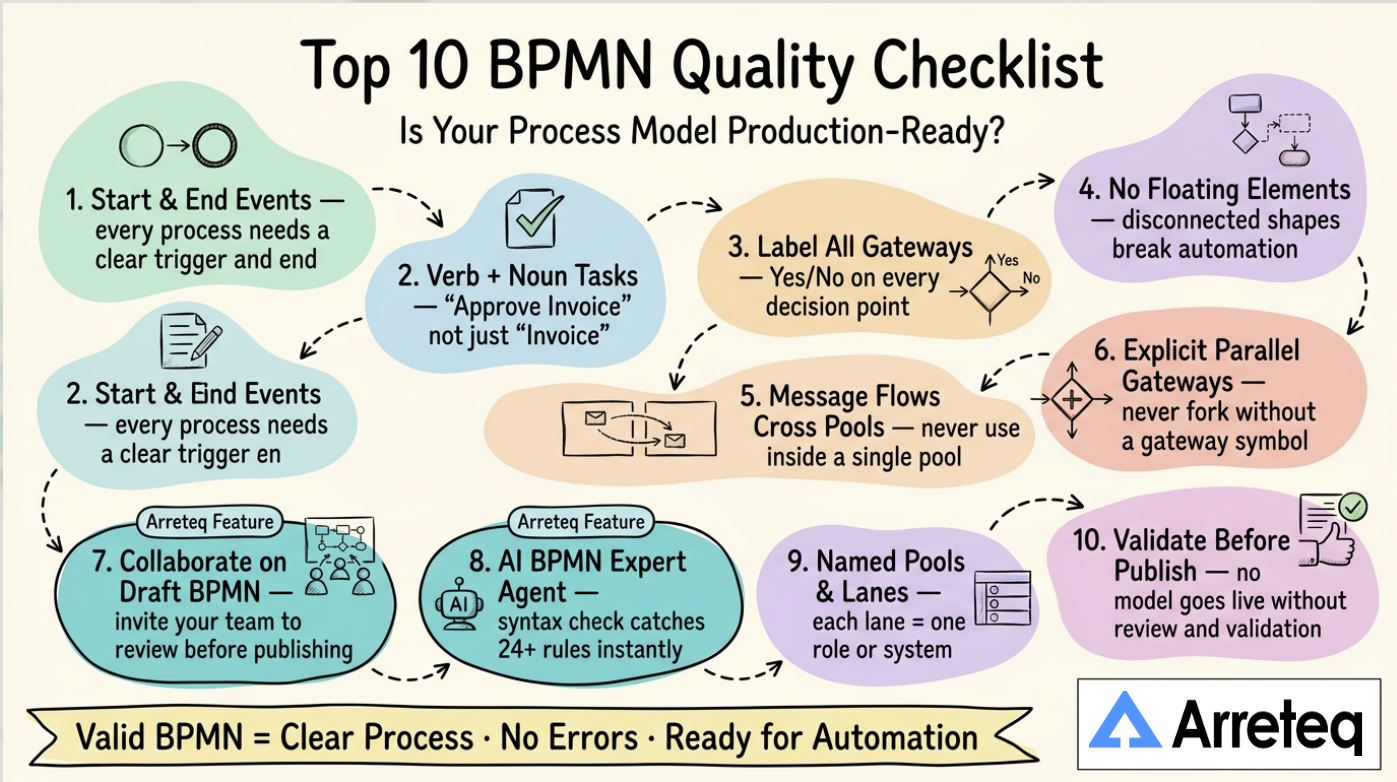
The 10 Rules
1. Every Process Has a Start & End Event
Every BPMN process must have at least one Start Event and one End Event. Without a Start Event, there is no defined trigger — the process engine does not know when to begin. Without an End Event, the process has no termination point, which causes execution to hang or fail silently.
This is the most fundamental rule in BPMN, and it is broken more often than you would expect — especially in quickly sketched diagrams or models imported from other notations.
Rule: Every pool must contain at least one Start Event and one End Event.
2. All Tasks Labeled With Verb + Noun
Task names must describe an action, not just name a thing. A task called “Invoice” tells you nothing about what happens. A task called “Approve Invoice” is immediately clear to any reader.
The Verb + Noun convention is the BPMN industry standard for task naming. It makes models readable to both business stakeholders and technical teams, and it dramatically reduces the time needed to understand a process during review or audit.
Rule: Every task name must follow the format: [Verb] + [Noun] — for example, “Send Confirmation Email”, “Review Contract”, “Update Customer Record”.
3. All Gateway Conditions Are Labeled
Every outgoing sequence flow from an XOR (exclusive) gateway must have a condition label — typically “Yes” / “No”, “Approved” / “Rejected”, or a specific business condition.
Unlabeled gateway exits are one of the most common causes of silent process routing errors. When a process engine reaches an unlabeled split, it either throws an error or routes incorrectly — and neither outcome is acceptable in a production environment.
Rule: Every outgoing flow from a gateway must have a clearly written condition label. No silent splits.
4. No Floating or Disconnected Elements
Any element in a BPMN diagram that is not connected to the process flow — a task with no incoming or outgoing sequence flow, an event sitting alone on the canvas — is invisible to the process engine.
Floating elements are usually the result of copy-paste errors, incomplete edits, or diagram cleanup that was never finished. They pass visual inspection easily but cause validation failures when the model is imported into any BPMN execution engine.
Rule: Every element must be connected to the flow. No orphaned tasks, events, or gateways on the canvas.
5. Message Flows Only Cross Pool Boundaries
In BPMN, there are two types of connecting arrows: Sequence Flows (solid arrows, within a pool) and Message Flows (dashed arrows, between pools). They are not interchangeable.
Message flows represent communication between separate process participants — for example, between a company and a customer, or between two independent systems. Using a message flow inside a single pool is a BPMN standard violation that breaks tool compatibility and confuses readers.
Rule: Message flows (dashed arrows) may only connect elements across different pools. All internal flow must use sequence flows (solid arrows).
6. Parallel Gateways Are Always Explicit
When a process splits into multiple paths that execute simultaneously, a Parallel Gateway (+) must be used. Splitting a sequence flow into multiple outgoing arrows without a gateway creates implicit parallelism — behavior that is undefined in the BPMN standard and interpreted differently by different execution engines.
This is a subtle error that is easy to miss visually but causes significant problems when a model is automated.
Rule: Never fork a sequence flow into multiple paths without an explicit Parallel Gateway. Always use the correct gateway type for the intended behavior.
7. Collaborate on Your Draft BPMN Before Publishing
— Arreteq Feature
A technically valid BPMN model can still be wrong. Wrong scope, wrong responsibilities, wrong exception handling — these are business-level errors that no syntax checker can catch. The only way to find them is through structured human review.
Arreteq allows you to invite stakeholders directly into a draft model before it is published. Process owners, developers, and compliance officers can comment on specific elements, suggest changes, and sign off — all within the platform, without email chains or version confusion.
- Comment on specific tasks, gateways, or swimlanes
- Suggest changes without altering the main diagram
- Track who reviewed what, and when
- Resolve all feedback before the model goes live
Rule: Every process model should be reviewed by at least one subject matter expert before it is published. Use Arreteq’s collaboration feature to make this a structured, traceable step — not an informal email.
8. Run a Syntax Check With the Arreteq AI BPMN Expert Agent
— Arreteq Feature
Manual review catches business errors. Automated validation catches technical ones. Both are necessary — and neither replaces the other.
The Arreteq AI BPMN Expert Agent runs a comprehensive syntax and best-practice check on any diagram in seconds. It covers all the rules in this checklist, plus 16 additional BPMN 2.0 compliance checks, and explains every issue in plain language with a suggested fix.
- Instant detection of syntax violations and missing elements
- Plain-language explanations — not just error codes
- Direct links to the affected element in the diagram
- Suggested fixes for every flagged issue
Rule: Run the Arreteq AI BPMN Expert Agent on every model before it is shared or deployed. Do not rely on manual review alone for syntax compliance.
9. All Pools and Lanes Are Named and Owned
Every pool and every swimlane in a BPMN diagram must have a name that clearly identifies the participant, role, department, or system it represents. An unnamed lane is a process with no owner — and a process with no owner will not be executed correctly.
This rule is especially important in cross-functional processes where multiple teams are involved. Clear lane ownership makes responsibility assignment unambiguous and prevents the “I thought that was your lane” problem during implementation.
Rule: Every pool and lane must have a name. Each lane must map to exactly one role, team, or system.
10. Validate Before You Publish
A BPMN model is not finished when the drawing is done. It is finished when it has been validated — both by people and by tooling.
Validation before publishing is the single habit that separates process teams that ship reliable models from those that spend their time fixing broken automations and rewriting diagrams after the fact. Build it into your workflow as a non-negotiable final step.
Rule: No BPMN model leaves a draft state without passing both peer review (Rule 7) and automated validation (Rule 8). Validate before you publish — every time.
Key Takeaway
Valid BPMN = Clear Process · No Errors · Ready for Automation
The first six rules on this list are universal BPMN best practices — they apply regardless of which tool you use. Rules 7 and 8 are built directly into Arreteq, making structured collaboration and automated validation a seamless part of your process modeling workflow rather than an extra step you have to remember.
Process quality is not about perfection on the first draft. It is about having the right checks in place before a model reaches production.